
Sand Rock Aggregate Processing
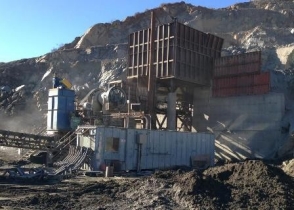
Sand, Rock and Aggregate Plants are operated by the mineral product industry to process sands, rocks, aggregates or recycled concrete and asphalt. The materials processed by these plants are transported to the site or are blasted from an on-site quarry. These plants typically include crushers, screens, conveyors, loadout system, stockpiles, storage bins and haul roads. Crushers used by these plants include jaw crushers, cone crushers and impact crushers. Common screen types include grizzlies, shaking or vibrating screens.
Air contaminant emitted from operations of these sand, rock and aggregate plants include particulate matter and toxic air contaminants. Particulate matter emissions are controlled by water spray, fog spray, surfactant, covered screen and covered conveyor, or by venting crushers, screens and conveyors to baghouses. Emissions from haul roads and material storage areas must also be controlled by watering or other control measure.
Plants are powered by electricity or by diesel engine generators. If the plant is powered by diesel engine generators and the diesel engines have their brake-horsepower rating of 50 bhp or greater, please complete the application forms for non-emergency engines.
The information on this page will assist in the completion and submittal of an application for each gas turbine. Each section of the page contains important information needed to submit an application.
Portable equipment under this category that is not operated
at a stationary source may be eligible for registration instead of
permitting. See the District's registration
page for additional information.
- FORMS
- FEES
- SUBMIT
- APP STATUS
- REGULATIONS
- ASSISTANCE
Application forms tell us about your operation and allow us to permit your process. Accurate and complete information decreases processing time and helps avoid additional charges for unnecessary revisions. Please carefully review and complete the following forms. Also listed below are required attachments that need to be submitted with the application. You may contact the District with any questions.
CEQA Supplemental Form: Word PDF
Screening Supplemental Form Word PDF (For screen sets with no associated crushers)
Load-out Only Supplemental Form Word PDF (For processes with load-out only)
Sand, Rock and Aggregate Processing Supplemental Form Word PDF (For all other equipment)
Required Attachments
- Facility Plot Plan including crushers, screens and conveyors locations, stockpile and storage bin locations, haul roads, property boundary line
- Process flow diagram including material throughput in tons per hour at each transfer point
- Crusher and screen specification/data sheet
- Crusher, screen and conveyor drop heights
- Stockpile areas
- Quarry blasting activities (if applicable), including total annual blasted amount, total annual blasted area, horizontal area per blast, explosive type, explosive amount per blast, number of blasts per year.
- Control equipment specifications (if applicable)
- BACT analysis including manufacturer/supplier cost estimates (if applicable)
The general and equipment specific
application forms along with required attachments must be submitted
with each application packet.
The correct application fee, as calculated using the fee estimate form tool below, must be submitted along with your application in order for it to be accepted. Additionally, please include the completed estimate form with your application.
Note: The estimate is designed to provide a good starting point for work on most applications; however, certain situations may require specific types of review that require additional fees. The District will review your application and determine if any of these specific considerations apply and will contact you and provide an invoice if additional fees are necessary. This may occur immediately or as SDAPCD begins processing the application.
Fee Estimate Form (see instructions below)
Instructions: In order to determine the proper application fee, please complete the Fee Estimate Form using the instructions below based on the specifics of your application.
"Applicant Site ID/EIF ID” – For applications at existing facility please provide the Site ID number.
“Reason for Submittal” - Each application must list a reason for submittal. This should be indicated by selecting a numerical category and a subcategory. The reason for submittal is a critical piece of information as it is necessary to create the fee estimate for your application. You will enter this same information into the general application form. Please utilize the following for guidance on selecting the appropriate option.
1 - New
Equipment/Permit - This category includes any application for an
authority to construct, permit to operate or certificate of
registration for new equipment or existing equipment which does not
currently have one.
a. New Installation - Use for
installation of equipment which has not been installed and that is not
a replacement of equipment which currently has a permit.
b.
Existing Unpermitted - Use for equipment which has already been
installed and either previously had a permit or never had one. Does
not include equipment replacement.
i. Equipment already
installed - Includes equipment which has already been installed which
required an authority to construct or certificate of registration at
the time of installation.
ii. Loss of Exemption - Use
for applications for existing equipment which newly require a permit
or registration due to a change in District Rule 11 or other loss of
permit exemption.
iii. Re-permitting - Select for
equipment which previously had a permit to operate but the permit was
cancelled or retired.
2 - Modification
to permit or application – Use this category for any application
to change or revise an existing permit, including equipment
replacement and change of location.
a. Equipment
Modification/Replacement - Physical modification of existing
equipment, including replacement of equipment.
b. Like-Kind
Replacement - Replacement of equipment with “Like Kind” as defined in
District Rule 11 which does not require an authority to
construct
c. Change to Permit Conditions - Changes to
existing permits which do not propose any physical
modifications.
d. Amend Existing Application - Used when
applying for a revision or change to an existing open application or
authority to construct.
e. Change of Location - Used to
change the location of an existing permit, which requires an authority
to construct.
f. Change Permit Status - Used to inactivate
or reactivate an existing permit. Select the appropriate category.
3 - Other -
Use this category for special categories of applications outside of
standard authority to construct and permit applications.
a.
Change of Ownership - Required when changing ownership of a permit or
piece of equipment. Provide proof of ownership with application. (List
affected PTO Record ID(s))
b. Title V - Use when applying
for a new Title V permit and for any revisions to an existing Title V
Permit.
c. Risk Reduction Plan - Use for applications to
implement or revise Rule 1210 Requirements.
d. Emission
Reduction Credits (ERCs) - Select this option when requesting the
issuance of new ERCs and for transfer or surrender of ERCs.
e. Other - Includes applications which do not fit into any other
categories (please describe in “Equipment Description” section of
form)
(*If you are indicating the reason for submittal is Like Kind
Replacement, this will result in a lower fee, but please ensure you
are familiar with the requirements to qualify under this provision
as not all replacements are eligible. If you have a question
regarding applicability of this application type, please contact the District.)
“Equipment Type” - Using the dropdown menu, select the equipment type that describes your equipment.
“Applicant DBA” - Enter the company name/DBA of the owner/operator of the equipment
“Existing Site” - Select whether the location (site) is new or existing (i.e. has existing permits with the District).
“Affected Permit Number” - For changes to existing permits, enter the permit number. For amendments, enter the application number being amended.
"Estimate Date” – This is the date the form is filled out.
“Equipment Description” – Please enter a brief description of the equipment for which the permit is being applied for.
“Special
Considerations” - Complete any of the special consideration drop
downs that apply.
a. "Number of Crushing
Systems", "Number of Screening
Systems", "Number of Loadouts". Indicate the
number of each type of equipment that is being proposed or affected by
the application. When determining the quantity, it is per processing
line (i.e. primary crushing vs. secondary crushing, primary screening
vs. secondary screening). For example, a new facility installing 1
primary crusher and 2 secondary crushers in parallel would indicate
"2" in the crusher box. A modification to an existing
facility adding a tertiary crusher to this same facility would
indicate "1" in the crusher box..
b.
"Outstanding Permit Fees" - If your permit was
previously retired for non-payment, you may owe back fees. Indicate
yes in this box, and contact the District to determine what total
amount is owed. This must be paid prior to apply to reactive your
permit.
c. "Split Payment" - The District
has a split payment option. This allows the application to be paid in
four installments. If you wish to request this option, indicate yes
and the total fee will be divided in four, plus an additional
processing fee is paid with the first application.
d.
"Application is a minor modification" - The
estimate sheet assumes a certain amount of engineering review time for
each type of T&M permit revision; however, applications that don't
significantly alter the equipment or emission often require less time
to review. This box can be selected to reduce the estimated review
time and engineering service fees for this type of minor revision.
Please note that even if this box is selected an invoice will be
issued for any additional engineering time needed to complete the
evaluation beyond the initial estimate.
e. "HRA Fee
not applicable..." - District
Rule 1200 requires that an HRA be conducted for any project that
results in an increase in Toxic Air Contaminants. The estimate sheet
assumes that most applications require this fee; however, certain
applications may not increase emissions or a project may consist of
multiple applications where only one fee is required. If either of
these is the case for your application, use this box to remove the HRA
fee, but note that if this fee is required an invoice will be issued
for the additional amount.
The specific fees that must be included are determined by District Rule 40 and can include fixed fees and/or time and material (T&M) based fees. Please note that T&M based fees are estimates and can vary based on the amount of work necessary to complete the review of the application. Additionally, review of certain requirements, including Health Risk Assessments (HRA), New Source Review (NSR), California Environmental Quality Act (CEQA), and others are also assessed on a Time & Material basis.
Note for Multiple Applications - If you are submitting multiple applications simultaneously, a single fee estimate sheet can be used if all equipment is within the same fee schedule and you are applying for multiple permits. However, note that a single application record will be created for each individual application.
If you are submitting multiple applications simultaneously and wish to take advantage of the multiple identical equipment lower fee provisions of Rule 40, complete an estimate form for the first unit, and then a separate form for the subsequent units, with the reason for submittal as “Additional Identical Unit, Applying Same Time”.
NOTE: The fees listed in this estimate are intended to be the deposit necessary to begin work on your application. In most cases, fees will be accurate; however, some fees are estimates of time & material based fees and the final fee may be more or less than the estimated amount. If additional fees are owed, you will be invoiced for these fees and if any fees are remaining after approval, these will be refunded. Work records are kept for purposes of establishing time and material based fees.
How to Pay
Fees may be paid by check payable to "Air Pollution Control
District" or by credit card. Checks can be mailed or dropped off
to SDAPCD, 10124 Old Grove Rd, San Diego, CA 92131. Please include
your APCD SITE Record ID with the payment.
The San Diego
County APCD (District) accepts VISA, Master Card, and American Express
Cards. Credit card payments will be assessed a processing fee of 2.19%
of the amount paid by credit card. This processing fee covers only
costs assessed to the District by credit card providers. If you pay by
credit card, please contact our Accounting department by calling (858)
586-2600 between the hours of 9a-12p or 1p-4p. Accounting can also be
reached at APCDFiscal@sdapcd.org.
The District will act on complete applications as soon as possible but at most within 180 days. The engineer assigned to your application will review it and contact you within 30 days of receipt to confirm that it is complete or request additional information. Typically permits are issued in about 60 days. More complex processes will take longer. Common reasons that applications may take longer than 60 days to evaluate include: the project is a complex project specifically at a major source, if the project requires a mandatory public notice period due to being installed within 1000 feet of a school or triggering the requirement for a air quality impact analysis (AQIA), if they do not initially pass a health risk assessment (HRA) or AQIA, if BACT is not proposed or complete BACT analysis is not submitted or for major sources if actual emission data is not included.
Ensuring your application is complete is the best way to reduce processing time. Complete emissions data is the most important factor in minimizing application processing time and iterative information requests. If you have any questions about what information is required, please contact the District using the information on the Assistance tab.
Sign up for Citizen Access to get up to date information on the status of your application.
Learn more about the permitting process and what to expect.
Best Available Control Technology
If a piece of equipment or a process emits more than 10 pounds per day of particulate matter (PM10), oxides of nitrogen (NOx), volatile organic compounds (VOC) or oxides of sulfur (SOx), the application must include a best available control technology (BACT) analysis. For sand, rock and aggregate processing, this is typically triggered by PM10. Please note that the 10 pound per day threshold is based on emissions from the entire process line, not just a single emission point and includes fugitive sources.
If you have questions or need assistance reference the BACT Guidance Document or the contact information on the assistance tab. Please review District Rules 20.1 and 20.2.
Toxics
District Rule 1200 applies to any new, relocated, or modified emission unit which may increase emissions of one or more toxic air contaminant(s). The proposed project must comply with Rule 1200. Proposed equipment may require toxics best available control technology (TBACT) depending on the project. Please review District Rule 1200 for further details.
Trade Secret
District rules address how information that is submitted to the District is managed. District Regulation IX contains District Rules 176 and 177. Please refer directly to these rules when submitting trade secret information. However, be aware that you will need to submit:
- You must indicate on the general application form that your submittal includes trade secret information to ensure that it is not inadvertently made publicly available.
- A letter disclosing the proprietary information. Ideally, this information should be separated from your application and clearly identifiable. This can be submitted electronically, and can be a separate submittal from the main application package.
- A letter for the public record explaining why the information needs to be held as trade secret or is otherwise exempt from disclosure.
Applications submitted with incomplete material composition data due to failure to include proprietary information can significantly delay permit applications. In an effort to expedite the permit application process it is recommended that you contact the manufacturer or vendor of any proprietary materials that are used in the process and prepare the required letters as part of your application submittal.
AB3205
In 1989, the California state legislature passed a law, AB 3205, designed to protect schoolchildren from hazardous air contaminants. The law, as currently written, requires the District to notify parents of schoolchildren, neighboring businesses and residents of all new or modified equipment that emits any hazardous air contaminant into the air which will be installed within 1,000 feet of a school site. The law also requires the District to consider any comments before authorizing construction. Please review your proposed location. If a school property boundary is located within 1,000 feet of the proposed emissions point, the AB3205 process will be initiated. This process requires a 30 day public comment period and the overall process will delay projects by at least six weeks.
NESHAP/NSPS/ATCM
This equipment is subject to Federal
New Source Performance Standard (NSPS) subpart OOO. Requirements
of this rule depend on this size of the equipment, construction date
and equipment type. Screens that are not associated with a process
including a crusher are not subject to the rule. Major requirements of
the rule include particulate and opacity standards, monitoring and
record-keeping requirements and initial testing.
District Rules
Several District rules may apply to your equipment. General rules that may apply to this equipment include Rules 50, 51, 52, and 54.
There are no equipment specific rules for this equipment. A complete listing of the District's rules can be found here.
Calculation Procedures and Additional Resources
Equipment Calculation Procedures - This page contains procedures to be used for calculating emissions from this equipment that should be submitted with each application.
Use of these calculation procedures will aid in minimizing application review time and costs. The correct emission factors should be selected from the list based on equipment. If available, manufacturer provided equipment specific emission data or source test results should be utilized before using default emission factors. Sources of all emission data used must be included as attachments to the application.
AP-42 - An alternative compilation of emission factors and calculation procedures prepared by the EPA that may be utilized by the District in some situations for some equipment types.
Need Assistance With:
When contacting us, have your SITE ID, permit/application numbers
(if applicable), and equipment details ready.
Submitting Forms and Fees:
For assistance on submitting forms and fees, please reach out to Permit Processing and see the "Fees" tab above. For assistance with making payments, please contact our Fiscal Department and provide your application number.
Phone: (858) 586-2600
Permit Processing Email: apcdpermits@sdapcd.org
Fiscal Email: apcdfiscal@sdapcd.org
Completing Forms or Compliance:
For assistance filling out application forms or help understanding your permit conditions to stay in compliance, contact our Business Assistance specialist.
Phone: (858) 586-2650
Email: APCDSBA@sdapcd.org
Technical Questions:
For other technical questions related to your equipment, please contact the Engineering Division. Please be prepared to describe your equipment and reason for applying so we can connect you to the right engineer
Phone: (858) 586-2600
Email: apcdengineering@sdapcd.org